
When Hitting Target Still Feels Empty (The Problem Nobody in Sales Talks About)
You've done everything right. The number is there. So why doesn't it feel as good as it should?
$1.06m in a Single Quarter. And All I Felt Was Relief.
It was a Tuesday night. I was sat alone in my house.
Wired. Refreshing my inbox.
Flicking between LinkedIn and Salesforce, waiting for one final deal to process with finance.
This email came in at 6:39pm:
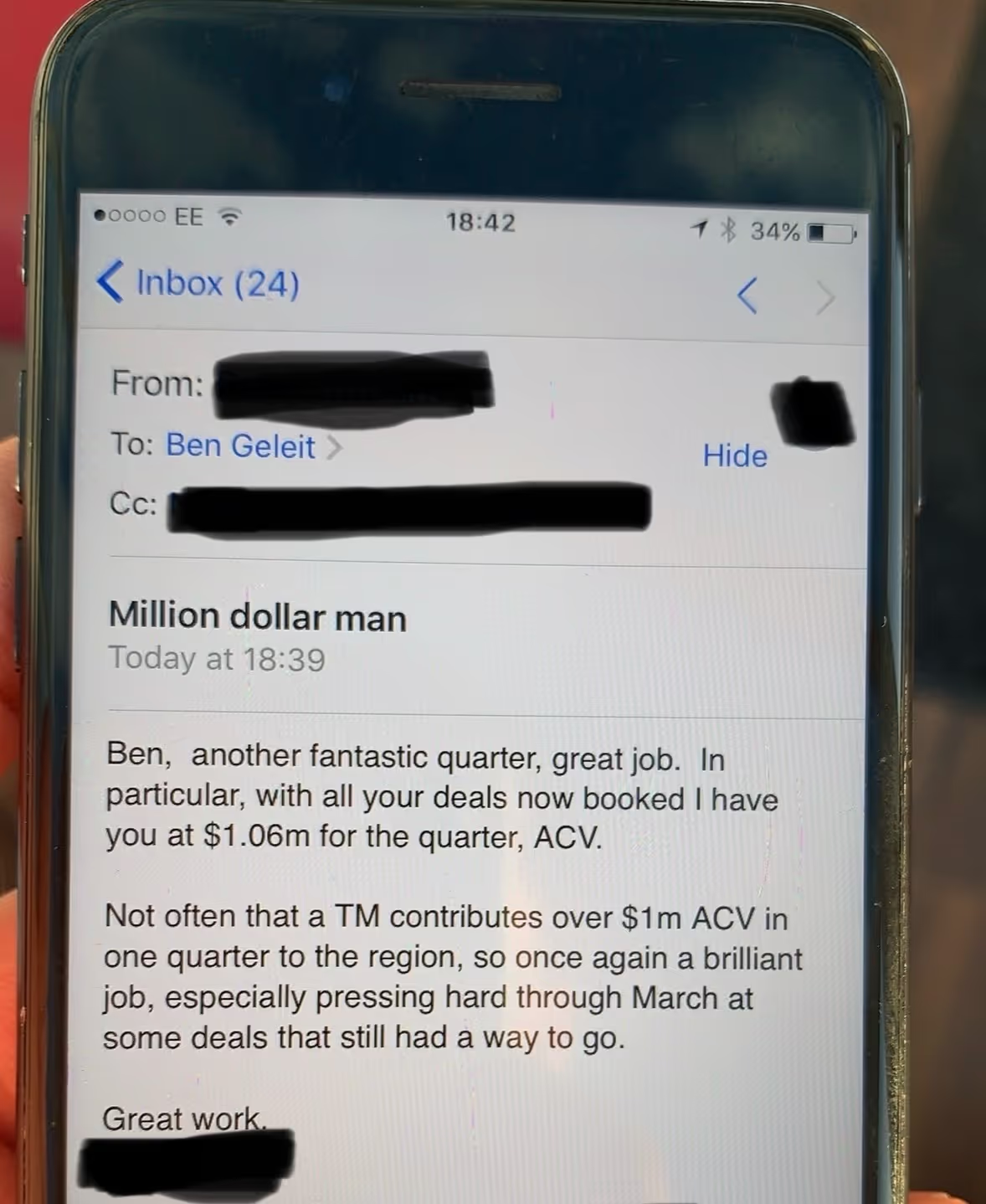
All I felt was relief.
Not pride.
Just relief that I hadn't failed.
"Thank fuck I made that commit."
Wednesday morning, back at zero.
Friday, pipeline anxiety had taken over and the quarter was already forgotten.
$1.06m or $100k - same internal response: onto the next one.
I didn't even notice at the time. It was "just Sales."
Looking back, I know exactly what was happening.
How I saw myself as a person depended on whether I hit my number.
Hitting target was never good enough because the clock just reset the next day.
I didn't burn out from working too hard.
I burnt out from never letting a win validate me.
If you've ever closed something big and felt absolutely nothing - or worse, felt the pressure get heavier instead of lighter - this is for you.
The Quiet Crisis Behind the Dashboard
This isn't burnout. It's not stress. It's not even dissatisfaction with the role.
It's something harder to name.
It's the gap between what your life looks like from the outside and what it feels like on the inside.
The gap between performing well and feeling well.
Between doing fine on paper and quietly questioning whether this is all there is.
Only 30-33% of reps are consistently hitting quota right now. So you should feel good about being in the top third, right?
You don't. Because the win was supposed to mean something.
The target was supposed to be the finish line. You crossed it. And nothing changed inside.
I worked with a Senior AE at a SaaS startup who described this perfectly.
Seven years in sales. Closing deals. Earning well. Living in Barcelona.
From the outside, it looked like he had it figured out.
From the inside, his career satisfaction was 4 out of 10 and he was waking at 5am with his mind racing about deals that might not close. He was seriously considering quitting.
When I asked him what was going on, he said something I've heard dozens of times since:
"I shouldn't be in sales. This isn't for me."
He wasn't underperforming.
He was over-identifying.
His entire sense of self was riding on the number.
Good quarter, good mood.
Bad quarter, everything felt wrong.
Same person. Same skills. Completely different relationship with himself depending on his achievement against target.
This isn't a career problem.
It's an identity problem.
If you want to want to understand why this happens, this post on self-worth and your number breaks down the pattern.
The Quota Achievement Identity Trap
Here's the science behind what's happening.
Psychologist Albert Bandura's research on self-efficacy shows that when your confidence comes exclusively from outcomes you can't fully control, it creates a fragile sense of self.
You feel competent when the deals close. You feel worthless when they don't.
Your identity fluctuates with your attainment.
Author James Clear puts it differently:
Every action you take is a vote for the type of person you want to become.
If the only votes you're casting are quota-related, you end up with a one-dimensional identity that collapses the moment the number wobbles.
Neuroscience backs this up.
The brain regions that process "who am I?" - the medial prefrontal cortex and posterior cingulate cortex - update through repeated evidence.
If the only evidence you're feeding them is deal-won or deal-lost, your brain literally builds a self-concept around a Salesforce dial.
Maxwell Maltz, the surgeon who wrote one of my favourite books: Psycho-Cybernetics, called this the self-image thermostat.
You perform to the level of the identity you hold.
If your identity says "I'm someone who hits target," you'll work like hell to stay there. But you won't feel fulfilled.
Because "someone who hits target" is a function, not a person.
That's exactly where I was.
17 consecutive quarters over quota at Ivanti. Three President's Clubs. £9.6m sold over five years.
On paper, huge success in tech sales.
But my identity underneath was entirely tied to those numbers.
When I moved to a role where the environment shifted and the numbers didn't come as easily, the whole thing fell apart.
Not because I lost my skills. Because I'd never built a self-concept beyond where I was against my quota.
That AE in Barcelona?
Same pattern.
When we challenged his belief that he "shouldn't be in sales" with actual evidence, he paused.
There was nothing behind it. No evidence at all.
It was just a thought his brain had been repeating because it didn't have anywhere else to anchor his identity.
How to Rebuild an Identity Beyond the Number
This is where the Sales L.O.O.P.™ Method applies to identity - not just performance.
Listen.
Get honest about where your self-worth is actually coming from right now. Score it.
If someone asked you "who are you outside of work?", what would you say?
If the answer is difficult to find, that's the signal.
Notice when your mood shifts after a deal outcome.
Notice when you dismiss a personal win because it didn't involve revenue.
That's your identity talking. And right now, it's running on a single data source.
Organise.
Write down the evidence that you're more than your quota.
This sounds simple. It isn't.
That AE I mentioned: He'd been in sales for seven years. Built a life in Barcelona. Spoke multiple languages.
Ran an audio and events side hustle. Had a relationship, a routine, a creative life.
None of it registered in his self-image because none of it was tied to a number on a dashboard.
When he actually listed it out, the picture was overwhelming.
The person he was had almost nothing to do with the deals he was closing.
Optimise.
Start casting identity votes outside of work.
James Clear's framework here is practical:
Every small action is a vote for the type of person you want to become.
For me:
A morning run isn't about fitness. It's a vote for "I'm someone who looks after themselves."
Playing guitar on a Wednesday evening isn't a hobby. It's a vote for "I have a life outside sales."
Setting a hard stop at 6pm isn't lazy. It's a vote for "I'm someone with boundaries."
Stack enough of these votes and your brain starts updating its story about who you are.
Perform.
Run the experiment for one week.
Track which identity feels stronger - the one tied to your quota, or the one you're building.
The AE I worked with built a morning routine around exercise, guitar, and cooking.
He reclaimed a three-hour dead zone that his brain had previously filled with deal anxiety.
His career satisfaction went from 4 to 8.
Not because he closed more deals.
Because he built a self-concept that didn't collapse every time a prospect went quiet.
And here's what happened next.
Five months after we stopped working together, his average deal size had jumped 71%.
He consistently hit target. His personal routine was never more consistent.
Sales performance improved as a byproduct of the identity work.
Not the other way around.
The After Picture (It's Not What You Think)
This isn't about caring less about work. It's about caring about more than work.
Another Senior AE I worked with put it like this after his programme:
"I am good at what I do. Realising that work isn't my personality and there can be a divide between the two."
He'd spent 12 weeks building that divide.
Playing golf on Friday afternoons. Going to the football again. Making social plans he'd stopped making because the weeks felt "too hectic."
Setting boundaries he'd never have set before.
And closing deals with logic instead of desperation, because his entire sense of self no longer hung on the outcome.
The change isn't dramatic from the outside.
Same role. Same target. Same pipeline.
But inside, the relationship to all of it changes.
You stop performing from fear and start communicating with conviction.
You stop dreading QBRs and start treating them as data.
You stop wishing your weeks away and start being present in them.
This isn't a luxury.
For a mid-career AE who's already capable, it's the unlock for a career in Sales that has longevity and feels good.
Find Out Where the Leak Is
If this sounds familiar, the problem isn't your pipeline or your target or Sales.
It's your personal operating system.
Take the free Sales Reset Scorecard to see exactly where your purpose, energy, mindset, and focus are leaking.
It takes three minutes.
You'll get a personalised breakdown of your results and a clear picture of what's actually driving the emptiness - so you can start fixing the right thing.

The next quarter will fly by. Where do you want to be by then?
Find out what's holding you back. Takes 3 minutes.

Join the In the LOOP newsletter today
Sign up for In the Loop and receive weekly insights packed with actionable strategies and tools. Designed specifically for sales people, our newsletter helps you achieve calm, confident and consistent performance.